
Voltage Drop Calculator
Long cable runs lose voltage, which can make motors run hot, lights dim and equipment misbehave. Enter the circuit voltage, load current, one-way length and conductor, and the calculator shows the voltage drop, the percentage and the voltage at the load — and recommends the smallest wire size that keeps the drop within your target.
- Free to use
- No sign-up
- Runs in your browser
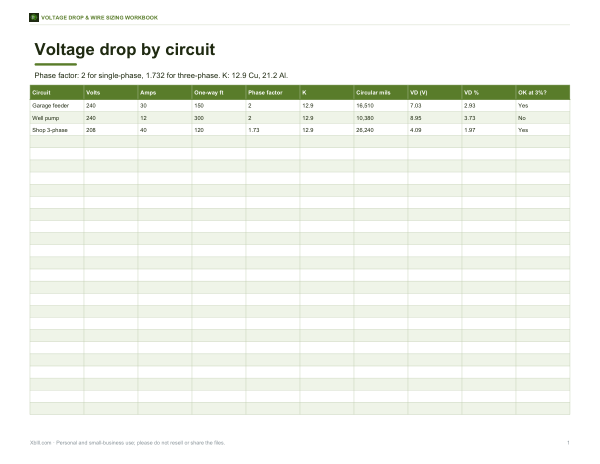
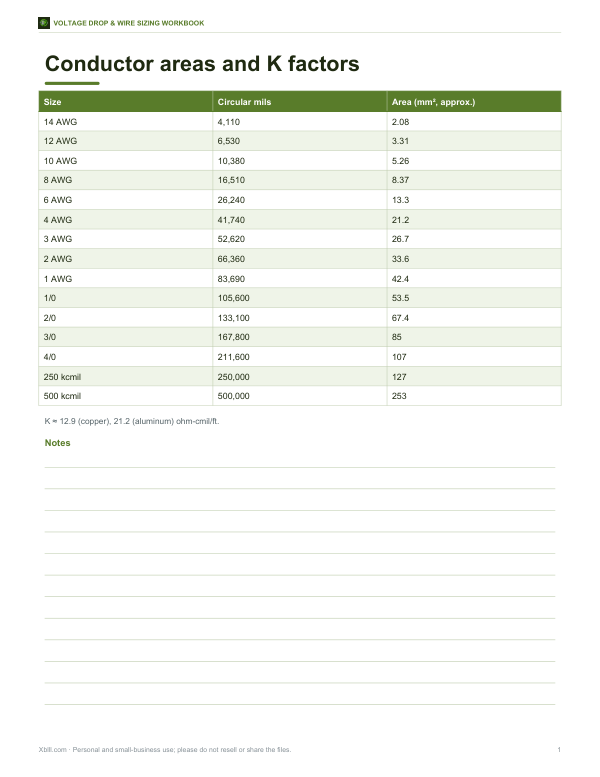
Voltage drop calculator
Voltage Drop & Wire Sizing Workbook
Excel voltage drop workbook for single- and three-phase circuits with automatic wire size check, a printable circular mil and K-factor chart, and a feeder and branch circuit schedule.
- Voltage drop workbook (XLSX)
- Circular mil & K chart (PDF)
- Circuit schedule (XLSX)
Formats: XLSX, PDF. Instant download after payment (link valid 72 hours, up to 5 downloads). AI-assisted: the templates were drafted with AI help and reviewed and laid out before publishing.
$5.00 USD, one-time 3 files · about $1.67 each
- Instant download
- 7-day refund
- Secure checkout by Stripe
7-day money-back guarantee. Full refund within 7 days of purchase, even after you download.
Full refund within 7 days — see the refund policy and license.
Free printables
Single sheets you can print right now, no sign-up. The full pack adds every sheet in one download plus the editable files.
What voltage drop is
Every conductor has resistance, so when current flows some voltage is lost along the wire, turning into heat. On short runs the loss is negligible, but on long runs — to a garage, well pump, outbuilding, EV charger or lighting at the end of a long driveway — it can be significant. Equipment then receives less than its rated voltage: motors draw more current and run hotter, lights dim, and electronics may reset or fail to start.
The voltage drop formula
For single-phase (and DC) two-wire circuits: VD = 2 × K × I × L ÷ CM. For three-phase circuits: VD = 1.732 × K × I × L ÷ CM. Here K is the resistivity constant of the conductor (about 12.9 ohm-circular mils per foot for copper and 21.2 for aluminum at typical operating temperature), I is the current in amps, L is the one-way length in feet, and CM is the conductor area in circular mils. The factor 2 accounts for current flowing out and back; three-phase uses √3.
Recommended limits
A widely used guideline, found in informational notes to the US National Electrical Code, is to keep voltage drop to no more than 3% on a branch circuit and no more than 5% in total for feeder plus branch circuit. These notes are recommendations for efficiency and performance rather than mandatory limits in most cases, but some equipment and some local codes have stricter requirements. Sensitive or motor loads benefit from lower drop.
Circular mil areas
| Size | Circular mils |
|---|---|
| 14 AWG | 4,110 |
| 12 AWG | 6,530 |
| 10 AWG | 10,380 |
| 8 AWG | 16,510 |
| 6 AWG | 26,240 |
| 4 AWG | 41,740 |
| 2 AWG | 66,360 |
| 1/0 | 105,600 |
| 2/0 | 133,100 |
| 4/0 | 211,600 |
| 250 kcmil | 250,000 |
Each step of three AWG sizes roughly doubles the area and halves the voltage drop.
Worked example: a detached garage
A 240 V single-phase feeder to a garage carries 30 A over a 150-foot one-way run. With 8 AWG copper (16,510 cmil), VD = 2 × 12.9 × 30 × 150 ÷ 16,510 = 7.03 V, or 2.93% — just within a 3% target, leaving 233 V at the garage. With 10 AWG copper the drop would be about 11.2 V (4.7%), too high even though 10 AWG might carry the current. For future loads, the owner might choose 6 AWG (4.43 V, 1.8%).
Ways to reduce voltage drop
- Use a larger conductor — the most common fix.
- Use a higher voltage: the same power at 240 V draws half the current of 120 V, and the percentage drop falls by a factor of four.
- Shorten the route where possible.
- Reduce the load on the circuit or split it across circuits.
- For very long runs, consider a sub-panel near the loads fed by a larger feeder.
Copper vs aluminum
Aluminum has about 1.6 times the resistance of copper for the same size, so aluminum feeders are usually one or two sizes larger for the same voltage drop. Aluminum is lighter and cheaper for large feeders and service entrances, and modern aluminum alloys and terminations are widely used, but terminations must be rated for aluminum and installed correctly.
Voltage drop and EV chargers, pumps and outbuildings
Loads that draw steady high current over long distances are where voltage drop matters most. An electric vehicle charger drawing 40 A continuously on a long run to a detached garage, a well pump hundreds of feet from the house, or a workshop with a table saw and compressor can all suffer from undersized conductors. Motors are particularly sensitive: low voltage at start-up increases current and heating and can cause nuisance tripping. When in doubt, size up; the extra copper or aluminum is usually cheap compared with problems later.
Metric conductor sizes
Outside North America, conductors are sized in square millimetres. The same principle applies: VD = 2 × ρ × L × I ÷ A for single-phase, using the resistivity of copper (about 0.0175 Ω·mm²/m at 20 °C, higher at operating temperature) and length in metres. Many countries set voltage drop limits in their wiring regulations — for example 3% for lighting and 5% for other uses from the origin of the installation in some standards — so check the rules that apply where you work.
Limits of the calculation
This calculator uses the common DC-resistance method, which is accurate enough for most building wiring at typical sizes. For large conductors, long AC runs, or circuits with low power factor, reactance matters and a more detailed calculation using impedance values from code tables gives better results. Temperature also affects resistance: hotter conductors have higher resistance. For design work, follow the applicable code and consult a qualified electrician or engineer.
Privacy
All calculations run in your browser; nothing is stored or uploaded.
Frequently asked questions
How do I calculate voltage drop?
Single-phase: VD = 2 × K × I × L ÷ CM; three-phase: VD = 1.732 × K × I × L ÷ CM.
What is an acceptable voltage drop?
A common guideline is 3% on a branch circuit and 5% total including the feeder.
Is L the round-trip length?
No, enter the one-way length; the formula accounts for the return path.
What is K for copper?
About 12.9 ohm-circular mils per foot (21.2 for aluminum).
Does voltage drop affect ampacity?
They are separate checks: a wire must meet both ampacity and voltage drop requirements.
Does voltage drop waste energy?
Yes, the lost voltage becomes heat in the wire, so larger conductors also reduce energy losses on heavily used circuits.
Is my data stored?
No, it runs in your browser.